
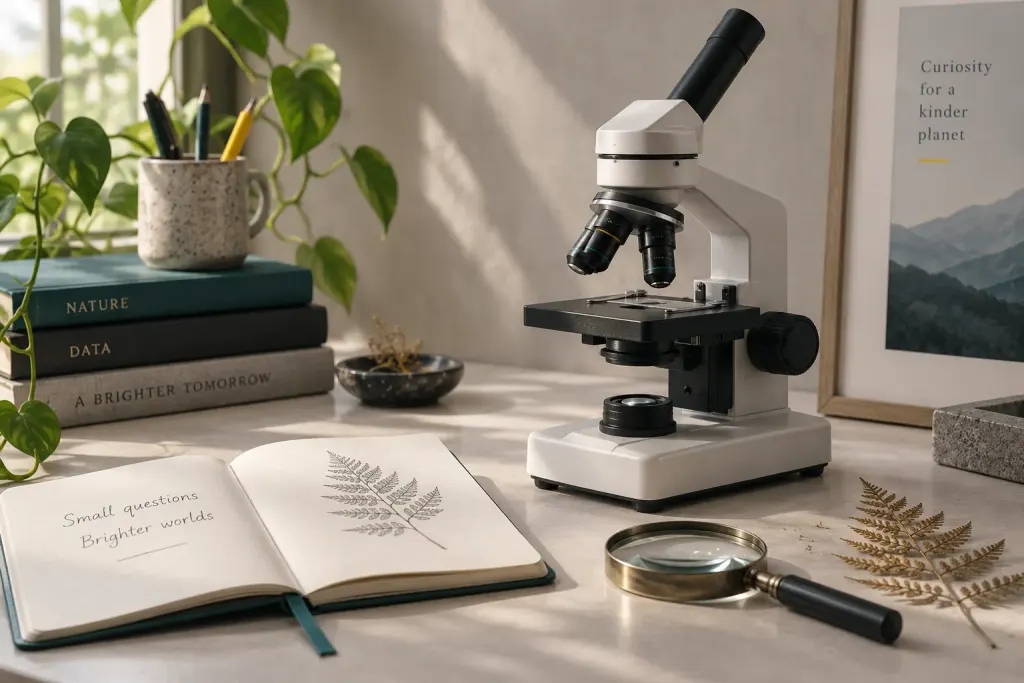
A leaf has pale patches. “The plant lacks nutrients” is one possible explanation, but it is not the same kind of statement as describing the patches themselves. A notebook becomes more useful when those two kinds of entry remain distinguishable.
This original exercise can be done with a photograph or a common object. It does not require collecting organisms or changing a habitat.
Describe what is available to observe
Record colour, shape, location and extent in plain language. Include the date and conditions if you are making a real observation. Avoid labels that smuggle in an explanation before it has been checked.
For an invented leaf example, “three pale areas near the edge” is a starting description. A photograph can preserve context, but lighting and camera processing may affect apparent colour.
Put possible explanations in a separate column
List more than one possibility where appropriate and mark them as hypotheses. You do not need to rank them immediately. The aim is to prevent the first plausible story from becoming an unnoticed assumption.
Do not diagnose plant, animal or human health from this exercise. Investigating a real problem may require specialist knowledge and appropriate methods.
Ask what additional observation would help
Would another angle, a repeated observation or information about conditions clarify the question? Choose a step that can be taken without harming the subject or intruding on private property.
Write down what you expect to learn before collecting more information. Otherwise, it is easy to gather details without improving the question.
Preserve the original note
If your interpretation changes, add the new explanation and the evidence that prompted it. Do not rewrite the first entry to make it look as though you knew the answer all along.
Our introduction to model organisms explores how focused questions support research. At a much smaller scale, a two-column notebook teaches the useful habit of separating what is seen from what is inferred.